
There is a number in TPG‘s history that explains more about its present than any disclosure it has made since.
Forty-eight per cent.
That was the EBITDA margin on the old Corporate division in FY19 – the enterprise, government and wholesale business, running on fibre the company owned. Not a gross margin. Not a segment contribution struck before the awkward bits. An EBITDA margin, of forty-eight cents in the dollar.
It had not arrived by accident. $643 million of revenue and $242 million of EBITDA in FY15. $754 million and $330 million by FY18 – earnings up by roughly a third, and the margin climbing from thirty-eight per cent to forty-four. Then $367 million, and forty-eight.
Nothing left in the building produces numbers like that. What remains produces a fixed business earning $22.25 of gross margin per user per month, a premium mobile brand that has not added a net postpaid customer in years, and an underlying continuing result, before tax, of seven million dollars.
It printed money.
So they sold it.
What It Actually Was
The division has a dull name in the accounts and it flatters nobody to describe it in segment language, so consider what it was instead.
Fibre the company owned, sold to customers who sign contracts rather than shop weekly. Governments. Corporates. Wholesale carriers buying capacity. Relationships measured in renewal cycles rather than promotional ones, with counterparties who negotiate hard once and then behave predictably for years.
No handsets. No SIM swaps. No thirty-day suspensions, no activation raffles, no six-month discount cliffs, and not one customer in the history of the division ever telephoned to complain that the advertisement had featured an American comedian.
It compounded, which is the entire point of it and the reason forty-eight per cent was achievable. Enterprise fibre is a business where the capital goes in once, the asset sits in the ground for thirty years, and the revenue arrives whether or not anybody has thought of a campaign.
The figures above were drawn to this masthead’s attention by a telecommunications executive with long familiarity with the business, who has given permission for their use. They are not confidential. They sit in the annual reports of the pre-merger company, where anybody could have found them, and where almost nobody has looked since.
The Price Was Fair. That Is Not the Objection.
$5.25 billion was real money and it was, on any reasonable view, a fair price. Nothing here suggests the assets went cheaply, that the board failed to extract value, or that the transaction was other than a properly considered commercial decision. Value was extracted. That is what the transaction was for.
The $5.25 billion answered the question of what the assets were worth.
It did not answer the question of what the company intended to become without them.
Total Peripherals Group
To understand how odd the present arrangement is, it helps to know where the initials came from, because almost nobody does.
TPG stands for Total Peripherals Group. It was founded in 1986 as an IT company selling OEM computers – hardware, in boxes, to businesses. This is not obscure. It is the first entry on the company’s own corporate timeline.
Follow the thread from there and the shape of it is genuinely remarkable. A hardware reseller becomes an internet provider. The internet provider lists via reverse takeover in 2008. By 2015, per the company’s own account, it is “the second largest internet service provider in Australia, and the largest mobile virtual network operator.”
Read that last phrase again. In 2015, TPG was the country’s largest MVNO. It rented network capacity from somebody else and resold it.
Today it is on the other side of the same trade, wholesaling capacity to resellers – including, most recently and most visibly, to a brand whose customers spent the winter trying to leave. The company that got large by renting somebody else’s network now rents its own out to companies whose customers are departing. There is a circularity there that no strategy document has attempted to explain.
And the hardware has come back. The current fixed wireless offer ships a Wi-Fi 7 modem, free, postage included, at $39.99 a month for six months. Forty years after Total Peripherals Group, the company is once again putting equipment in customers’ hands.
It has simply stopped charging for the equipment.
Discover Our Story
Which brings us to the timeline itself, and this is the part worth reading slowly, because it is the single most eloquent document the company has published.
Under the heading Discover our story, the corporate website sets out the history in dated entries. 1986, the founding. 1993, Vodafone‘s arrival in Australia. 2008, the listing. 2009, the formation of Vodafone Hutchison Australia. 2015, the MVNO milestone. 2018, the merger announcement. 2020, the merger itself, and with it the promise of “Australia’s leading challenger full-service telecommunications provider.”
Then 2022: the Vodafone Foundation Australia is renamed the TPG Telecom Foundation.
Of everything that has happened to that entity, the timeline has selected the name.
(Posts #75, #86, #88.)
Then 2023: the corporate headquarters moves to Barangaroo. More than half a million trees are planted.
Then 2024: the regional network sharing arrangement with Optus.
And then the timeline stops.
There is no 2025 entry. There is no mention of the fibre network. There is no mention of the fixed enterprise, government and wholesale business. There is no mention of $5.25 billion, which is the largest single transaction in the company’s history.
The company’s official story of itself contains the renaming of a charity, the address of an office, and a tree count. It does not contain the sale of the network.
One does not wish to make too much of a marketing page. But somebody maintains that timeline. Somebody added the trees. And somebody, at some point in the last year, has looked at a corporate history ending in 2024 and concluded that no further entry was required.
What Owner-Operators Do Differently
There is a structural point underneath all of this that has nothing to do with any individual’s competence.
The business that built the forty-eight per cent margin was run by a founder with his own money in it. Founder-operators are frequently difficult, occasionally wrong, and reliably indifferent to the half-year narrative, because they are not managing a reporting period.
They are managing an asset they intend to still own in fifteen years. That produces decisions which look unglamorous for six halves and obvious in the seventh: fibre in the ground, contracts signed long, margin defended rather than purchased.
What replaced it is a listed company with two foreign parents on the register, a board on which four of ten directors are associated with them, a brand licensed from one of them, and a remuneration framework that settles annually.
Nobody in that structure is doing anything improper. Everybody in it is responding rationally to what they are measured on. Which is how a company arrives at a position where the division that compounds is disposed of and the division that discounts is defended, and the result is described, in the company’s own investor materials, as a “strong challenger spirit.”
He walked the North Ryde office at night turning off monitors. Not as a stunt for a profile piece – there were no profile pieces – but because a monitor left on overnight is money leaving the building, and he had put his own money in it.
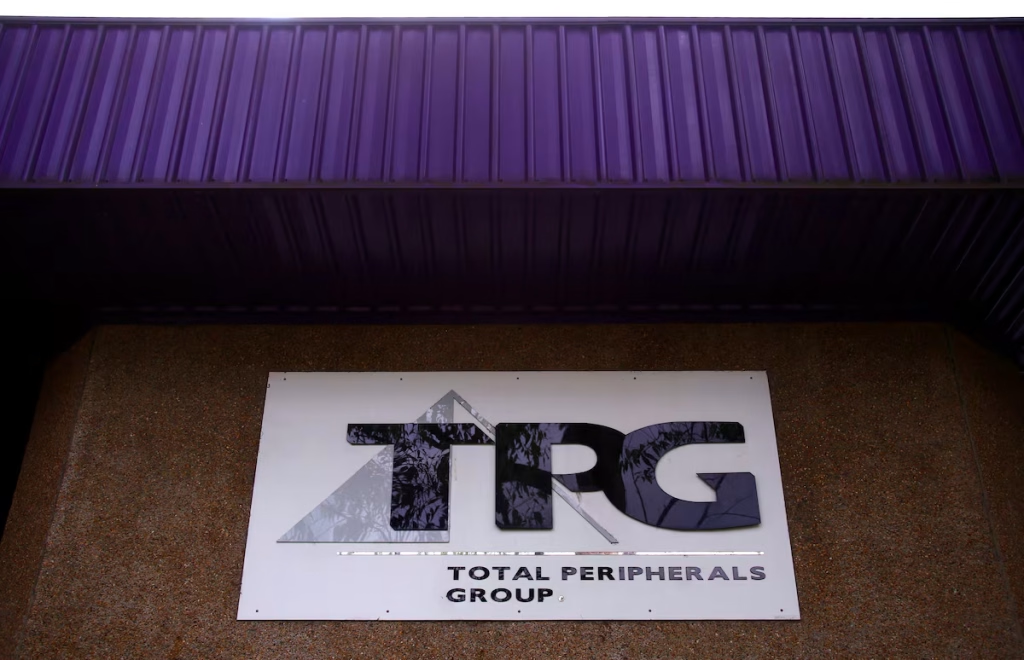
Herring Road, North Ryde. Forty-eight per cent came out of this building.
That is the culture that produced forty-eight per cent. Not a strategy deck. A man switching off screens on Herring Road.
He still holds roughly eight per cent of what the business became, and a member of his family sits on the board. Which means the founding interest is not a spectator to any of this. It is represented in the room, in a company that has since sold the fibre, sold and leased back the towers, sold the receivables twice, cut capital expenditure by a hundred million dollars, and paid dividends that have on occasion exceeded its free cash flow.
The discipline that built the forty-eight per cent has a vote. It does not appear to have a majority.
A man who turned off monitors to save electricity now owns eight per cent of a business that pays dividends its earnings do not cover.
And something close to a control group exists, which is the part that closes the argument.
The same operator went on to build Tuas in Singapore – clean growth, coherent strategy, the same operating DNA, and none of the structure described above.
It works. The obvious inference is not that one executive is better than another. It is that the discipline was never the hard part.
Keeping it was.
Nothing in this article is attributed to him. He has said nothing about any of it, and nothing here should be read as his view. He simply owns eight per cent and can read the accounts like anybody else.
The Scoreboard Nobody Adjusts
A listed company controls a great deal of its own narrative. It sets the bonus targets. It selects the pro-forma. It decides which metrics appear in the investor deck and which are retired in the half they become awkward – the churn percentage, the ARPU components, the interconnect breakdown, all present when they flattered and absent when they did not.
There is one number it does not set.
Since listing in 2020, the shares are down well over sixty per cent. Not down against a peak struck in a bubble. Down against the price at which shareholders were invited to vote for the merger that was going to create Australia’s leading challenger full-service telecommunications provider.
Six years, and the market has formed a view. It is not a view about any individual, and it is not a view anybody at the company can restate on a different basis.
Nor is the company in any doubt about it, which is the part that removes the last available excuse. TPG discloses a return on invested capital of 5.42 per cent. It also states a cost of capital of seven to eight per cent.
Read those two figures together and the company has published, in its own investor materials, a negative spread between what its capital earns and what it says that capital costs.
And 5.42 is the flattered number. Return on invested capital is a fraction, and the denominator is the capital. Sell the handset receivables and the assets they sat on leave the balance sheet with them, which shrinks the denominator and lifts the ratio without a cent of additional earning.
The business did not improve. There is simply less of it to divide by.
On the company’s own numbers the spread is negative: 5.42 per cent earned against capital it says costs seven to eight. Not an allegation. A disclosure, in a presentation, in a font it chose, on a slide it designed.
Against which: $1.66 billion of EBITDA, and seven million dollars of underlying pre-tax profit. A dividend running ahead of free cash flow. Capital expenditure cut by a hundred million dollars. And a short-term incentive paid at 87.64 per cent of maximum.
This is what optics over economics looks like when it has been running long enough to show up in the numbers. Not fraud, not incompetence, and not a single decision anybody could point to as the error. A sequence of individually defensible choices, each of which improved a reported figure in the half it was made, assembling over six years into a company that earns less on its capital than the capital costs, and pays out at eighty-seven per cent of maximum for the achievement.
The founder turned off monitors because money leaving the building was money leaving the building.
The current arrangement has found rather more elegant ways for it to leave.
Home to Australia’s Most-Loved Brands
The same corporate page offers a description of the company that deserves quotation in full, because no summary improves it.
“We are home to some of Australia’s most-loved brands including Vodafone, TPG, iiNet, Internode, Lebara and felix.”
Most-loved.
Set it against a brand the company pays a licence fee to use.
Most-loved is doing a great deal of work in that sentence, and it is not being paid overtime.
The page continues: “a strong challenger spirit and a commitment to delivering the best services and products to our customers. We are driving competition and choice for businesses and consumers across Australia.”
Driving competition and choice for businesses, from a company that sold its fixed enterprise business to Vocus. It is the sort of sentence that survives a marketing review precisely because nobody in the room has read the segment accounts.
The phrase is not confined to the website. In June the company’s Group Executive for Enterprise, Government and Wholesale described a new wholesale agreement as “further proof that the strength of our mobile network is driving greater competition and giving Australians more choice.”
He speaks at a wholesale conference in October. The title, one notes, has outlived the division: Enterprise, Government and Wholesale, at a company that sold its fixed enterprise, government and wholesale business.
And then, the purpose statement: “to build meaningful relationships and support vibrant, connected communities.”
Australia’s second-largest listed telecommunications company, describing its reason for existing in language indistinguishable from a community garden’s grant application.
Somewhere in the old accounts there is a division earning forty-eight cents in the dollar, and the purpose of the enterprise that built it is now to support vibrancy.
Simplification
Assemble it and the shape is not complicated, which is presumably why so little has been written about it.
The company owned two kinds of business. One was low-margin, high-churn and capital-hungry, competing on price against two larger rivals in one of the most price-sensitive mobile markets in the developed world.
The other was a compounding infrastructure business with a forty-eight per cent margin, contracted revenue, and customers who do not read comparison sites.
It sold the second one. The first one is what remains.
The licence fee remains. So does the dividend. Capital expenditure has been cut by a hundred million dollars, and the accumulated tax losses that made the last seven million dollars a pre-tax figure are now exhausted, which means the next seven million will be worth rather less.
None of it is a scandal. All of it is disclosed, somewhere, in a document nobody is required to read.
The $5.25 billion was a fair price.
It printed money.
Someone else’s press now.
Right of Reply
TPG Telecom Limited, Vocus, Vodafone, Vodafone Group plc, Hutchison, and any director, officer or individual who considers themselves referenced in this article are warmly invited to correct, clarify, or add context to anything set out above – including, should they wish, the current EBITDA margin of any remaining enterprise operation, and the intended date of the next entry on the corporate timeline.
Verified responses sent to vodafailed@gmail.com will be published in full and without editorial amendment, alongside the original article. Unlike the fibre, the right of reply is not for sale.
Disclosure, Disclaimer & Legal Notice
This article is independent commentary, opinion and analysis on a matter of public interest.
Divisional figures. Revenue, EBITDA and margin figures for the pre-merger Corporate division are drawn from TPG Telecom Limited‘s annual reports for the relevant financial years and are reproduced or arithmetically derived from figures as filed. They were drawn to this masthead’s attention by a telecommunications executive with long familiarity with the business, with that person’s express permission for their use; they are publicly filed figures and are not confidential, privileged or non-public information. Segment definitions and reporting boundaries changed materially following the 2020 merger, and comparisons across that boundary are not like-for-like.
The Vocus transaction. The sale of the fibre network and fixed enterprise, government and wholesale business is a matter of public record. Nothing in this article asserts that the consideration was inadequate, that the board failed to discharge any duty, or that the transaction was other than a properly considered commercial decision. This masthead makes no claim as to the application of the proceeds of that transaction, and no inference should be drawn that any particular expenditure was funded from them. References to dividends, licence fees, capital expenditure and other outgoings describe disclosed matters occurring in the same period and are not statements as to the source of the cash applied to any of them.
The corporate timeline and marketing material. Quotations and descriptions of the company’s corporate website, timeline, purpose and values are reproduced as published at the date of writing and are subject to change; the observation that the timeline concluded with a 2024 entry describes the page as observed on that date. Corporate history pages are marketing materials rather than regulatory disclosures, and no allegation is made that any omission from such a page constitutes a breach of any disclosure obligation, law, regulation, code or standard. The company’s regulatory disclosure of the transaction is a separate matter and is not criticised here.
Current operating figures. Figures concerning fixed and mobile average margin per user, subscriber movements, capital expenditure, dividends and the taxation position are drawn from TPG Telecom Limited‘s own filed reports and investor materials. Where a figure has been derived, that derivation is described in the text.
Board composition, brand licensing and ownership. References to directors’ associations with substantial shareholders, and to brand licensing arrangements, describe matters disclosed by the company in its own filings. Nominee representation and brand licensing between a company and a substantial shareholder are ordinary and lawful. No allegation is made, and none should be read, that any director has failed to discharge any duty, that any related-party arrangement is improper or other than on arm’s length terms, or that any such arrangement has not been properly disclosed. The quantum of any brand licensing fee is not separately disclosed and none is asserted here.
Complaint data. References to ombudsman complaint movements reflect publicly available data as at the dates indicated and are subject to change. Readers should consult the primary sources.
Opinion and inference. Characterisations of strategy, incentives, corporate structure and the consequences of the disposal are the author’s honest opinion and reasonable inference drawn from publicly observable material. They are not statements of fact as to any party’s internal intentions, internal financial position or internal decision-making. No allegation is made, and none should be read, that TPG Telecom Limited, Vocus, Vodafone, or any related entity or individual has engaged in misleading conduct or breached any law, regulation, code or standard. No criticism is made of any individual named or referred to, including any founder or former executive of the businesses described. All entities and individuals retain the presumption of lawful conduct unless a competent authority determines otherwise.
All views expressed are the author’s honest opinions, formed on reasonable grounds, and are published in reliance on the protections afforded to honest opinion, fair comment and publication in the public interest under the Defamation Act 2005 (NSW) and its state equivalents.
This is not financial, investment or legal advice, and nothing in it constitutes a recommendation to buy, hold or sell any security. TPG Telecom, Vodafone, Vodafone Group, Hutchison, Vocus, iiNet, Internode, Lebara, felix, Optus, Telstra and related names are trademarks of their respective owners, used here for identification, commentary and analysis only.
The author has an active dispute with TPG Telecom Limited (ASX: TPG), has made protected disclosures under Part 9.4AAA of the Corporations Act 2001 (Cth), and holds an immaterial shareholding in TPG Telecom Limited. The author holds no interest in Vocus or any other entity named in this article, and received no payment or consideration in connection with the figures referred to. These interests should be weighed when reading this commentary.
Previous posts in this series:
Post #65 – When The Music Stops
Post #66 – The $2B Problem TPG Can’t Afford
Post #67 – The Bonus Year: Thin Earnings, Thick Optics
Post #68 – Buying the Narrative
Post #69 – The Smart Money Just Left the Building
Post #70 – Who’s Watching the Watchers?
Post #71 – Nine Lives: The Ad Agencies Vodafone Burned Through on the Way to Zero Growth
Post #72 – Marked Safe from the Whistleblower Policy
Post #73 – The Story Nobody Will Publish
Post #75 – The Gift That Keeps Giving
Post #76 – The Seat Nobody Wants
Post #77 – Houdini Never Filed a Form 605
Post #78 – Fifteen Years and a Footnote
Post #80 – Two Companies in a Purple Coat
Post #81 – Transformational: A $7 Million Result With a $1.6 Billion Costume
Post #82 – The Cartographer’s Apology
Post #85 – The Uninvited Guest
Post #87 – Acting On Instructions
Post #88 – Sequins and Silence
Post #89 – A Run of Unfortunate Weather
Post #91 – Eighty-Eight Per Cent
Post #93 – The Moose That Wandered Home
Post #95 – Statistically Insignificant
Post #98 – Overwhelming Demand
Post #99 – Discretionary Spending
Post #101 – Ladders and Snakes